Skip to content


Dark werewolf romance books should be fucking easy.
Seriously.
Take everything dark romance already loves to play with: obsession, possession, dangerous desire, compromised consent, power imbalance, a hero with questionable impulse control. Add the (deeply inadvisable) fantasy that somebody deciding you’re mine is intensely hot rather than grounds for a restraining order.
Then make him a wolf.
Job done, surely?
Except, weirdly, no.
If you follow the blog you will have noticed my descent into all things dark romance over the last little while. And I have a weakness for werewolf romance. I actually originally wrote Amelia’s trash romance obsession that recurs through The Cheshire Set as a werewolf romance addiction. But I had to switch it to cowboys because, frankly, I refused to concede the point that werewolf romance is trash.
I love shifter romance entirely too much. Ilona Andrews’ Kate Daniels series is a go-to comfort read. True Blood, The Vampire Diaries, Buffy, Teen Wolf, all among my favourite TV shows (though, no jokes, the original Sookie Stackhouse books genuinely are trash).
So Amelia became besotted with cowboy romance, a genre I’d never read at the time. And my beloved werewolf and shifter romances were saved from any kind of slur on their character.
Then I got into dark romance.
But the more I dug into genuinely dark werewolf and shifter romance, the more obvious it became that the overlap between werewolf romance and actual dark romance is astonishingly and (at first glance) inexplicably narrow.
Plenty of books have fated mates, possessive alphas, pack violence, biting, chasing, territorial growling and enough supernatural testosterone to require its own ventilation system.
Very few make the romance itself dark.
Naturally I applied myself immediately to reading as many as I could find in order to unravel the mystery. You know.
For science.
Because werewolves are predators. They’re instinctive, territorial, and animalistic. Their romantic mythology is already stuffed with involuntary bonds, scent recognition, claiming, hierarchy, loss of control.
Werewolves should be fucking perfect for dark romance.
So why are genuinely dark romance books about shifters and werewolves so bloody hard to find?
Quick Recs List: Dark Werewolf Romance Books Worth The Read
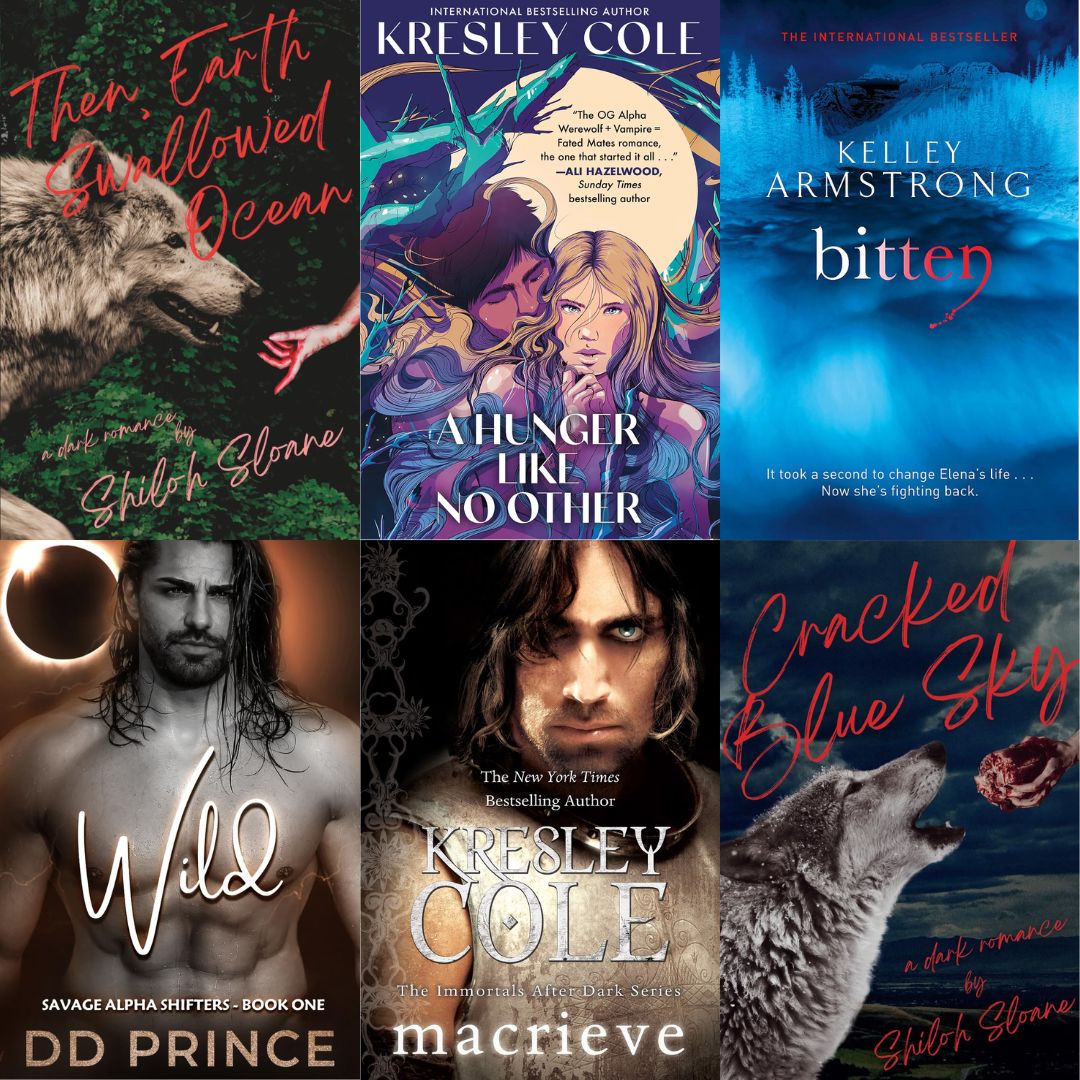
- Then, Earth Swallowed Ocean by Shiloh Sloane gives us werewolves that remain genuinely feral, frightening and monstrous, with enough horror running through the romance to make the danger feel real. 🖤🖤🖤🖤🖤
- Wild by D.D. Prince pushes the darkness into the relationship itself, where claiming, coercion and consent become considerably more consequential than simple alpha possessiveness. 🖤🖤🖤🖤🖤
- MacRieve by Kresley Cole takes that paranormal-romance ancestry somewhere much darker, using trauma, cruelty and the limits of forgiveness to make the central relationship genuinely uncomfortable. 🖤🖤🖤🖤
- Bitten by Kelley Armstrong starts Elena and Clay with a genuinely dark violation of agency when he turns her into a werewolf without her consent, even though their relationship becomes considerably safer as the Women of the Otherworld series continues. 🖤🖤🖤
- A Hunger Like No Other by Kresley Cole is part of the genre’s foundational alpha-werewolf and fated-mates DNA, with genuinely dark relational elements at the start before the romance settles into safer paranormal territory. 🖤🖤🖤
- Cracked Blue Sky by Shiloh Sloane keeps the same dangerous supernatural territory as Then, Earth Swallowed Ocean but shifts more of its darkness into murder, prejudice and abuse of power than into the romance itself. 🖤🖤🖤
- The Wolf King by Lauren Palphreyman kidnaps its Princess Aurora into a violent world of wolf clans, possessive alphas, and political danger, but its central romance turns the wolf into her protector considerably faster than it turns Callum into something she genuinely needs to fear. 🖤🖤
- Into Their Woods by Ivy Asher & Ann Denton is addictive, feral and high-spice, but sits closer to dark-adjacent shifter romance than the genuinely transgressive end of the genre. 🖤🖤
- The Tyrant Alpha’s Rejected Mate by Cate C. Wells uses rejection, hierarchy and a broken mate bond brilliantly, but proves that intense werewolf angst isn’t automatically dark romance. 🖤🖤
- My Little Doe by J. L. Rosenauer wraps its romance in captivity, grief, violence and a deeply dangerous werewolf world, but Quinn increasingly becomes Zay’s route to safety and healing rather than the source of the threat. 🖤🖤
🖤 About My Dark Romance Ratings: These black hearts rate how dark the romance itself is, not just how violent, graphic or disturbing the book is. They’re comparative within werewolf/shifter romance, so five hearts means the darkest end of this particular niche, not the darkest dark romance I’ve ever read. I’m working on a broader system, but until I work out how TF to quantify depravity without inventing the literary Richter scale, these are deliberately genre-specific. If you want the longer thought process on shifter and wolfish dark romance, read on…
Dark Werewolf Romance Has A Classification Problem
The biggest problem is that paranormal romance comes preloaded with things that look dark. Violence, pack hierarchy, fated mates, possessive alphas, primal attraction, and a hero who occasionally transforms into something with enough bite force to snap a steel sword in half.
But none of those things, on their own, make a romance dark. The sword biting bastard is a particularly good example, for while Patricia Briggs may write werewolf romance, she most assuredly does not write dark werewolf romance. Or particularly good werewolf romance a lot of the time. I’m afraid her books belong on the trash pile with Sookie, though the Alpha and Omega series with Charles the sword-biting menace was marginally better than the Mercy Thompson series.
I appear to have gotten sidetracked. What was the point? Oh, yes, werewolf romance isn’t trash (honestly), it just needs to be well-written. But dark romance only happens when the darkness gets inside the relationship.
When power changes what one person can demand from the other. Or desire compromises choice. Or possession genuinely collides with autonomy. Or attraction comes with danger that’s actually dangerous…you know, as in my boyfriend could kill me danger.
Dark romance is only present when the relationship asks the reader to tolerate, understand, eroticise or somehow emotionally survive behaviour that would be completely fucking unacceptable anywhere outside fiction.
A werewolf can massacre another pack, return home to his fated mate, worship the ground she walks on, respect every boundary she sets, and give her exactly the kind of emotionally secure relationship half the population is currently failing to find on Hinge.
Are they living in a dark world? Sure. Is it a dark romance? Almost certainly not.
When you’re adding werewolves or shifters to a romance the supernatural threat also has to matter to the intimacy. So it’s not enough for your werewolf to be an unhinged dude with a temper. If the power he gets from being supernatural doesn’t make the romance itself darker by default, it’s not dark romance.
Search dark werewolf romance books and Google will tell you the genre is ‘paranormal shape-shifting, intense power dynamics, and brooding alpha heroes’, then invite you to ‘browse more titles’ on Goodreads’ werewolf romance shelf, currently topped by Bride.
Which isn’t Goodreads’ fault. That shelf says werewolf romance and means werewolf romance. Nobody on it is claiming to be dark. And Bride is a bloody good werewolf romance book, which in fairness is also the darkest Ali Hazelwood book I’ve read. But it’s not a dark romance, and isn’t claiming to be. Yet Google will present it to you as top of the first list it cites.
The lists that do claim it are worse. BookRaid’s 11 Best Dark Romance Novels Featuring Werewolves gives you Moon Called, on the grounds that it has “a dark and romantic backdrop”, and Slave to Sensation because, and I quote, ‘Plus, it has werewolves.’
I’ll allow a certain amount of shifter drift, mind. Curran’s a lion. Lucas Hunter is a leopard. Shifter romance is close enough family to werewolves that I’m not going to get picky about a list including both (particularly since I’m including shifters in this discussion for exactly that reason; close enough). But five of the eleven aren’t shifter anything. Dark Lover is vampires. Kiss of Midnight is vampires. Dark Prince is Carpathians, so…vampires with better PR. And The Darkest Night is an immortal bloke with a demon living in him.
Then there’s Dead Until Dark, which fails the dark bar, the werewolf bar and the is-this-even-good bar all in one go.
Are they serious with this shit?
Romance.io is arguably worse, with 1,316 books tagged both dark romance and werewolves, with no reason given for either tag. Have a scroll through and you’ll find angels, vampires, witches and a fair amount of urban fantasy that does include wolves, but not as the love interest. Meanwhile, Everand’s entire definition of the genre is ‘brooding alphas, forbidden love, and thrilling plots’, which could describe virtually any romance genre because ‘alpha’ doesn’t have to mean ‘wolf’. Especially not in the world of dark romance where mafia, billionaire, and a score of other sub-genres run on alphaholes.
None of which is anybody sorting books. It’s everybody counting wolves.
Because a wolf is a thing you can count. Darkness isn’t. It’s a judgement about what’s happening between two people, and you can’t tag your way to it.
(All of which was true in September 2026, but Google’s answers change by the week. And, who knows, maybe this little article will shift the needle 😉)
The Dark Dial On Werewolf Romance
If Charlaine Harris’ books had actually contained the level of sadomasochistic undertones, graphically primal exchanges of bodily fluids, and raw trauma the show turned the vampire’s bite into, I’d probably rate them considerably higher. The books give southern whimsy (at least, in theory), but the show understood how to make that dark.
That’s the dial you’re looking for on werewolf and shifter romances. Are they using the supernatural elements to physically fuck with the relationship? Ilona Andrews’ Kate Daniels series is in no way dark romance, because Curran being a shifter doesn’t impact the nature of their intimacy in any real way. If anything it’s a comfort to Kate, his strength, his physicality, his overprotective nature. Drives her nuts, but never threatens her, never alters their dynamic. So while his supernatural power (and hers) make the world around them incredibly rich and at times exceedingly dark, it’s not dark romance.
Bitten by Kelley Armstrong
Kelley Armstrong’s Bitten complicates my neat little theory somewhat. It was the first proper adult paranormal romance book I ever read (aged sixteen-ish) and, naturally, I was seduced into it by the promise of wolves. The Women of the Otherworld series eventually wanders off into witches, demons, necromancers, and all manner of supernatural chaos.
But I remain, irrevocably, an Elena and Clay stan.
These books predate dark romance, and the series as a whole is definitely not dark romance. But, weirdly, the first book comes damn close. And that, I’m afraid, is probably why my teenage self fell so hard for this insane duo.
Clearly, it was a portent of things to come.
How it took me so long to start reading dark romance I’ll never know, because the more I think about it the more I realise I was reading it for years before it ever became a thing.
But anyway, back to Bitten. Clay doesn’t just reveal to Elena that werewolves exist. He turns her into one without her consent. Permanently. He makes an irreversible decision about her body, her identity, and the entire shape of the rest of her life because he wants her to belong in his world.
Which is really fucking dark.
It also only works because Clay is a werewolf. You couldn’t replace him with an overprotective billionaire and preserve a violation that permanently changes Elena’s body and identity. But as they settle into their relationship the darkness moves outside it. By Stolen they can literally hunt someone together as wolves: same capacity for violence, but once the danger stops existing between them, the romance stops being dark.
My Little Doe by J. L. Rosenauer
Then you get something like My Little Doe by J. L. Rosenauer, which sounds like somebody fed every phrase likely to attract me, personally, into an Amazon subtitle generator: dark romantasy, captor captive romance, werewolf shifter, slow burn.
Excellent.
Except, once again, the darkness isn’t quite where the label suggests it should be.
Zay is absolutely in a horrific situation. She’s abducted by her baby’s werewolf family, imprisoned, grieving, surrounded by violence, and Quinn begins the book standing on the wrong side of her prison door.
But he isn’t the thing she needs rescuing from. And he increasingly becomes the person offering safety, patience, trust, and eventually a route out of the situation she’s trapped in.
Which makes the ‘captor captive’ label particularly interesting. Because a genuinely dark captor/captive romance usually gets its power from the fact the person controlling your freedom is also the person you’re falling for.
The captivity contaminates the intimacy.
And, can we all take a moment for the obvious Beauty and the Beast segue here, in a discussion of love stories that F with power dynamics and involve men who take the form of beasts.
But, if the man you fall for isn’t the one who imprisoned you and spends most of the story becoming your route out of captivity, the dynamic changes completely.
So My Little Doe is dark, but the romance gradually becomes the place where Zay gets to heal from the darkness. And her love interest was never really the source of it. If falling in love makes the heroine safer rather than putting her in greater danger, the darkness still lives primarily outside the relationship.
Vampires Are Perfect For Dark Romance So Why Do Werewolves Suck At It?
I mentioned True Blood there for a reason beyond contrasting a safe supernatural power with an unsafe version.
Nobody thinks Alcide is anything other than a straight up guy who wants the best for Sookie. He’s not monstrous. He never bites her for fun, or control, or predation. No. That role lands squarely on the vamps of Bon Temps.
Yes, werewolves’ closest paranormal cousins have spent the better part of two centuries demonstrating exactly how beautifully a supernatural monster can fuck up a romance.
Vampires barely need encouragement. They were made for dark romance, and they do it incredibly well. Blood turns desire into hunger. Feeding makes a lover’s body a resource. Immortality makes forever sound like a threat. Turning someone can be rescue, violation, possession and devotion all at once. And restraint suddenly becomes incredibly fucking sexy because I want you so badly I can barely control myself carries the unsaid possibility of if I don’t control myself, you’ll die.
Werewolves should offer the same opportunity. Predation, teeth, animal instinct, territoriality, claiming.
Loss of human control.
Except werewolf romance has developed one particularly enormous habit that often pushes all of that danger in the opposite direction.
The mate bond.
Vampirism tends to create problems for intimacy, but werewolf mythology tends to solve them.
And therein lies the problem.
Fated Mates Should Be Dark Romance’s Wet Dream But Regularly Become A Wet Lettuce
On paper, fated mates are gloriously dark romance coded. Your body recognises somebody before your brain gets a vote. Attraction can become biological compulsion. Choice gets muddy. Possession suddenly has supernatural legitimacy. Walking away might be physically, psychologically or magically difficult.
That’s wonderfully fucked up.
There’s so much potential there.
But paranormal romance frequently takes this horrifying loss of romantic agency and turns it into the ultimate security blanket.
He’ll never leave you. He can’t replace you. He’s biologically compelled to want you. His entire body recognises you as uniquely his. Even in beast form, he knows exactly who you are.
No take backs, no substitutions, and unlike the vampiric promise for forever it doesn’t come with the lingering, claustrophobic notion of being trapped with the same arse hole for all eternity while they basically use you as a snack dispensary.
Werewolves took involuntary supernatural bonding and turned it into the answer to every emotional insecurity you ever had in a real-world relationship.
Impressive, honestly. And possibly why I’m so obsessed with it.
But it does create a problem for dark romance. Because fated mates are most interesting when the bond is properly fucked up. They’re considerably less interesting when the bond is just a shortcut to any kind of real emotional work and the HEA arrives by default.
Take Kresley Cole’s A Hunger Like No Other. One book helped cement so much of the alpha-werewolf/fated-mates DNA that now runs through paranormal romance. It’s foundational, but also exposes the whole problem.
If scent and instinct establish that these two people belong together before they’ve meaningfully chosen one another, the romance still has to convince us that biological inevitability has become emotional intimacy. It’s the same issue instalove always faces: sure, plot convenience means you two are hopelessly in love, but we’ve yet to see either of you feel anything real.
Then you get something like Cate C. Wells’ The Tyrant Alpha’s Rejected Mate and the whole thing becomes fascinating. It’s constantly swept into darker werewolf conversations, but it isn’t really doing the same thing as genuinely transgressive dark romance. The power comes from rejection, pack inequality, humiliation, damage, and the fact that destiny doesn’t get to finish the job.
The mate bond fails as an easy route to love, forcing the characters to actually build something, which is considerably more interesting once fate stops being ‘helpful’.
The Five Packs books are enormously popular in modern rejected-mate romance, but they repeatedly sit on the adjacent side of true dark romance rather than inside its nastiest little heart. Angst, pain, and rejection aren’t necessarily darkness.
Fated mates put the couple under pressure. That doesn’t automatically create depth. And the more the bond replaces choice, the less work the romance itself has to do.
A Feral Hero Isn’t Necessarily A Dark Hero
Once the actual wolf enters the equation this whole distinction gets a lot messier. Because ferality feels dark. Teeth, chasing, scenting, growling, possessive body language. The enormous man informing somebody that she belongs to him while everybody’s clothes somehow fail to survive the conversation.
But ferality can be little more than aesthetic.
A hero can act animalistic while remaining completely emotionally safe. He can be possessive without restricting the heroine, claim her without taking or forcing a thing, and repeatedly growl “mine” while every narrative consequence reassures us this ownership is just another language for devotion.
Which is fine.
Extremely fucking fine, honestly.
But it isn’t dark.
Possessiveness becomes genuinely interesting to dark romance when the heroine’s autonomy is actually threatened by it. It’s not the growl, but what the growl means. If it doesn’t mean you’re in imminent danger of being eviscerated if you try to refuse, sorry honey, but it ain’t dark.
The Darkest Werewolf And The Darkest Relationship Aren’t The Same Thing
Two actually dark werewolf books that are dark in completely different directions are Then, Earth Swallowed Ocean by Shiloh Sloane and Wild by D.D. Prince.
Then, Earth Swallowed Ocean gives us werewolves that feel genuinely (not aesthetically) feral. We’re not talking about handsome paranormal men who occasionally become beautiful wolves, or alpha MMCs wearing animal instinct like a leather biker jacket.
The animalism, the atmosphere, and the horror are visceral with these wolves. The danger doesn’t evaporate the second romance arrives. It’s violent, strange, erotic, and sufficiently committed to its own monstrosity that you’d be forgiven for bouncing right off it.
But the prose, the horror, the bloodiness of it all…nevermind being feral, that book sent me feral.
Then Wild does something else entirely, because the darkness in it doesn’t primarily come from a terrifying supernatural world. The relationship itself crosses lines. Consent becomes part of the conflict, claiming is far more consequential than sexy possessiveness.
The central question isn’t whether Tyson might hurt someone. It’s what happens when Ivy is on the receiving end of the thing that makes him dark.
Then, Earth Swallowed Ocean is dark through ferality, horror and supernatural menace, but Wild finds its darkness through relational transgression.
They’re both werewolf romances, and both genuinely dark romance, but they’re dark in different ways. So when you’re searching for something that scratches your particular itch in this genre, the best question isn’t “How dark is this?”, but “Where does the darkness live?”
The Difference Between Predation And Playing Chase
One of the easiest ways to neuter a monster is to introduce him to a heroine who immediately behaves as though none of his behaviour is particularly alarming. There’s a fairly enormous difference between being prey and playing at being prey. One is driven by survival and consumption, the other by social bonding.
Dark romance already demonstrates this perfectly without a single supernatural creature involved.
Zade doesn’t need fur and fangs to be a predator. When he chases Adeline, particularly before she’s sure what he wants or where his limits are, the fear works because she doesn’t know it’s a game. He may catch her. He may hurt her. She doesn’t yet possess the reassuring knowledge that whatever happens next will remain safely inside boundaries they’ve privately agreed.
That’s menace.
Compare that with Lights Out, which I love, but which operates at the fluffier end of dark romance to such an extent that I will happily argue elsewhere about whether it properly qualifies at all. By the end of the book, Aly and Josh can drive pleasantly into the woods and arrange a lovely little predator-prey scenario in which she runs, he hunts her, and if he catches her he gets to do exactly the sort of terrible things she is actively hoping he’ll do.
Fun? Sure. Hot? Obviously.
Dark because somebody’s being chased through a forest?
Not a fucking chance.
And tbh I found the whole scene a bit of a cringe letdown to the book. It was funny, but only because it was such a pathetic way to meet a beloved trope of the dark romance genre.
The difference isn’t the chase. It’s whether the woman being chased knows she’s safe.
One is genuine predation.
The other is predator cosplay.
And furries have just never been a kink of mine.
So, a man turning into a wolf and chasing his girlfriend through the trees isn’t automatically a dark romance. If she knows perfectly well he’s playing, and already mentally planning what he’ll do when he catches her?
If she has complete confidence that the thing with four legs and several pounds of teeth would sooner chew off its own paw than genuinely hurt her?
Then the wolf hasn’t made the romance darker.
He’s made date night more interesting.
And paranormal romance has been having fun with that for years.
Dark werewolf romance has a different job. If predation is part of the darkness, there has to be a point where she genuinely doesn’t know whether the wolf will hurt her. He needs to be actually bloody dangerous and, more specifically, a danger to her.
Into Their Woods is a great example of the boundary here. Noah’s fear when the supernatural world crashes into hers is bleeding through the page. She behaves as you’d expect a person to behave if they were suddenly dropped into shark-infested seas, finally hauled themselves back onto the boat, only to find the sharks turning into men and ravaging you on your yacht.
Except, you know. With wolves.
But Noah’s fear doesn’t automatically turn the book into a dark romance. It gets us closer, and gives the wolf real teeth, but the question is still basically, “But what happens when they catch her?”
In this case being caught means being bitten, but this is also a slow burn, and while it gets pretty scorching later on as Noah juggles multiple possessive and feral wolfmen (yes, this one’s a Why Choose, you’re welcome) her consent is never in question, there’s no coercion, no force mating or bonding.
The Wolf King by Lauren Palphreyman straddles the same border. It looks dark, Princess Aurora initially has genuine reasons to fear the supernatural situation, but the romantic relationship with Callum ultimately becomes safe.
Crossing The Line Is Cheap, A Convincing HEA Is Craft
Here’s the other problem with making werewolf and shifter romance properly dark: once you’ve actually made the bastard dangerous, you still have to somehow convince me he should get the girl.
Dark romance is supposed to cross lines and smash boundaries. The transgressive nature is literally what we came for. If everybody behaves rationally, communicates clearly, respects the word ‘No’, and spends 300 pages making emotionally healthy choices, well… that’s the wrong fucking genre.
I want the terrible decisions. The obsession. The moment that makes me think absolutely fucking not while feverishly turning the pages to see what happens next.
But making somebody (human, werewolf, or shifter) do something unforgivable is cheap.
It’s easy.
Making me believe the romance afterwards is considerably harder.
So any old hack can write a dark romance by slapping a bit of non-con or dub-con on the page, but writing a good one with a satisfying, believable HEA?
That’s craft.
Wild runs face-first into that problem: the more damage you allow one half of a couple to inflict on the other, the harder the HEA has to work.
You can’t spend half a book convincing me this man is genuinely a danger to her, then whip out a mate bond and expect me to forget everything because destiny said so.
Well.
You can.
I’m just going to complain about it. And we also really need to talk about consent here, because it’s a particularly slippery beast in werewolf romance.
Non-con between the main couple should settle the argument of whether a book counts as dark romance by default. Put it in any other romance and you’re in dark romance territory, because the love interest took something from the protagonist, and now the book has to make you believe they fell in love anyway.
Tall order.
Dub-con arguably has the same issue, though I’d caveat that if both participants know the no basically means yes, it’s a different conversation.
But in werewolf romance both non-con and dub-con usually arrive hand in hand with a mate bond that’s used to retcon any dodgy consent behaviour with a simple fix: She was his. He knew before she did. It’s biology, so he wasn’t really at fault.
It was fated.
That’s the safety blanket again. Just wrapped around the nastiest thing in the book.
And you can’t have it both ways. If the bond is what sells the HEA, it can’t also be the thing that makes the book dark romance. It’s already excused the darkness.
Playing The Trauma Card
MacRieve by Kresley Cole tackles the same problem from another direction. Will’s darkness is tangled up with horrific trauma, which makes him considerably more psychologically interesting than an alpha who’s simply a dick because the plot requires an alphahole.
But understanding why somebody became cruel doesn’t unmake the cruelty they have wrought.
Trauma can explain behaviour, make something monstrous tragically comprehensible, but it can’t do the emotional work of redemption on the character’s behalf. Look at Lana Myers in the Mindfu*ck series and you see trauma response used to deepen character and explain psychology, rather than excuse bad behaviour.
So giving Will a tragic backstory only goes so far. And it shouldn’t go further; I don’t need my monster to have secretly been a lovely bloke all along.
Frankly, that rather ruins the monster.
But if the book wants me to believe in the romance, it has to understand the weight of whatever it asked me to forgive. Whatever the monster expects the heroine to forgive in order for them to actually live happily ever after.
Shock is cheap.
Consequences are craft.
Which, I suspect, is why genuinely good dark werewolf romance is such a weirdly tiny pool. Even when you widen it to shifter romance and don’t limit the beast to a wolf, specifically, they’re bloody hard to find.
Not that there’s a shortage of extreme shifter romance.
Darkness has a volume knob and anybody can keep cranking it higher.
Writing something worth reading once you’re at full volume is considerably tougher.
Because I don’t just want more. I want the darkness to mean something. And I’d quite like all of that to arrive in a book with good prose, believable characters, decent pacing, and a plot that hasn’t been abandoned in a ditch somewhere around chapter twelve.
There are exceptions. Rina Kent’s novels spring to mind. But she’s not simultaneously expecting me to suspend disbelief over shapeshifting supernatural magical shit. The more non-human weirdness a book has to carry, the more grounded the human side of it needs to be.
That’s all I ask for. A little balance in my unhinged supernatural darkness.
Apparently I ask too much.
Though I do not ask the impossible. A large part of why Then, Earth Swallowed Ocean stands out so spectacularly is that it doesn’t just crank up the depravity dial and call it a day. The horror, animalism, and relationship all lock together and make coherent sense. The world, the romance, the supernatural shit is bizarrely believable despite being completely unrealistic.
And you couldn’t remove the werewolves without eviscerating the whole thing.
Cracked Blue Sky proves the point; Shiloh Sloane doesn’t rely on the same trick twice. A different book, another setup. One that moves towards murder mystery and romantic suspense. A great read, but I only gave the romance itself three black hearts because considerably more of its darkness lives in murder, prejudice, power, and the world around the couple.
Then you have a book like Wild. Far less polished in places but it absolutely nails the compulsion.
They’re different achievements.
A book can be compulsive without being accomplished. A book can also be beautifully written and not remotely dark.
Finding one that is properly werewolf, properly dark, compulsive and genuinely good is the literary equivalent of heading into the woods to stalk some sabretooth tigers.
You may find one, but it was probably written by Charlaine Harris.
Which explains why my recs list for this genre has so few titles with four or five dark hearts.
So Why Are Dark Werewolf Romance Books So Bloody Hard To Find?
After all of this, I think I was asking the wrong question.
It isn’t why does werewolf romance keep failing to make the wolf dark enough?
It’s why we wanted the wolf to be safe in the first place.
Here’s the thing, wolves have been waiting in the woods to eat us since we were children.
Fairytales taught us the woods were where you wandered when you left the path, broke the rules, escaped civilisation, went somewhere you weren’t supposed to go, did something you were warned not to do.
And the wolf was one of the things waiting to punish you for it.
The wolf was the danger.
That dynamic reversal cropping up in fairytale traditions has been called wild sanctuary. The dangerous wilderness becomes a refuge from human society, and the creature we expect to fear becomes guide, rescuer, or protector.
So…exactly what werewolf romance has been doing to us for years.
The woods are still dangerous.
The wolf is still terrifying.
But now he’s yours.
The thing everybody else is terrified of now stands between you and everything else that could hurt you. His violence becomes protection. His territoriality means nobody gets near you, and if they somehow do they die bloody. His obsession means he isn’t going anywhere.
The monster doesn’t even have to stop being monstrous.
You just get to be the one person he won’t eat.
The old threat becomes sanctuary. Which, as it happens, explains why Curran has been living rent-free in my head for half my life. The entire shapeshifter world in Kate Daniels is built around control. Loups are what happens when the animal wins completely, when the human consciousness loses its grip and bloodlust takes over. Curran watched his family brutalised and slaughtered by creatures who had reached that point. Curran survived, then built his entire adult life around the opposite: discipline, control, creating a Pack strong enough to stop other shapeshifters becoming the monsters that destroyed his family.
To create a world in which he can build a new family, with the woman he chooses.
And he chooses Kate.
Even Curran’s beast form proves the point. Most shapeshifters struggle to hold that halfway state between human and animal because maintaining it requires enormous control.
Curran’s is perfect.
Of course he feels safe.
He isn’t reassuring because the beast isn’t there. He’s reassuring because the beast is absolutely fucking enormous and he has mastered it. That’s the werewolf-romance fantasy distilled almost perfectly.
Not there’s nothing frightening in the woods.
There is.
It just belongs to you now.
And that creates one hell of a problem when you try to turn the same fantasy into dark romance.
Because dark werewolf and shifter romance can’t give you the complete exemption that makes us crave werewolf romance. By making it dark, you take away the security blanket.
You can still have the protection. You can still have the enormous terrifying creature that would happily rip anyone apart for so much as looking at you wrong. You can still have obsession, devotion, claiming, all-consuming supernatural desire.
But the wild thing has to remain wild even to you.
Which is why there are so bloody few genuinely dark werewolf and shifter romances. What we want from a werewolf or shifter romance and what we want from a dark romance are fighting against each other. When authors understand that, it works. When they don’t, you end up with a world that’s a lot darker, but a romance that’s still safe. Werewolves are much harder to write as dark romance than other monsters because of the nature of the beast in the fantasy.
A vampire can hunger for you and consciously choose restraint. He can want to drain every drop of blood from your body and still understand that would kill you. Every time he stops, the danger remains real because restraint itself is a choice. That’s the fantasy with vampires. And it’s a very different romantic indulgence to balance in the dark romance genre. The appeal with vampires naturally lends itself to darkness and doesn’t have to sacrifice the seductive elements we love in order to do it.
The werewolf as a dark romance hero presents a far more brutal question: What if instinct takes over completely?
What if the conscious man who adores you simply isn’t driving that beautiful, wild, feral thing he becomes?
What does love actually protect you from when the creature capable of killing you might not possess enough humanity in that moment to recognise you? To remember it loves you?
What if, even if it does, that’s not enough to curb the killer instinct?
That’s the dark romance potential werewolves have that vampires can’t touch, and I don’t think we exploit it nearly enough. Because being loved by the monster stops being a guarantee of safety.
He’s yours. But that doesn’t make you safe.
He’s obsessed with you. Devoted to you. Consumed by you.
And he might kill you anyway.
He might not have a choice.
Which is a considerably nastier version of the fairytale we started with.
The wolf’s still waiting in the woods.
You just fell in love with him. And no matter how much he loves you back, it might not be enough to save you.
And the darkest part of it all?
You don’t care. You’d rather be consumed than live another day without him.




 4.28 Average