Skip to content

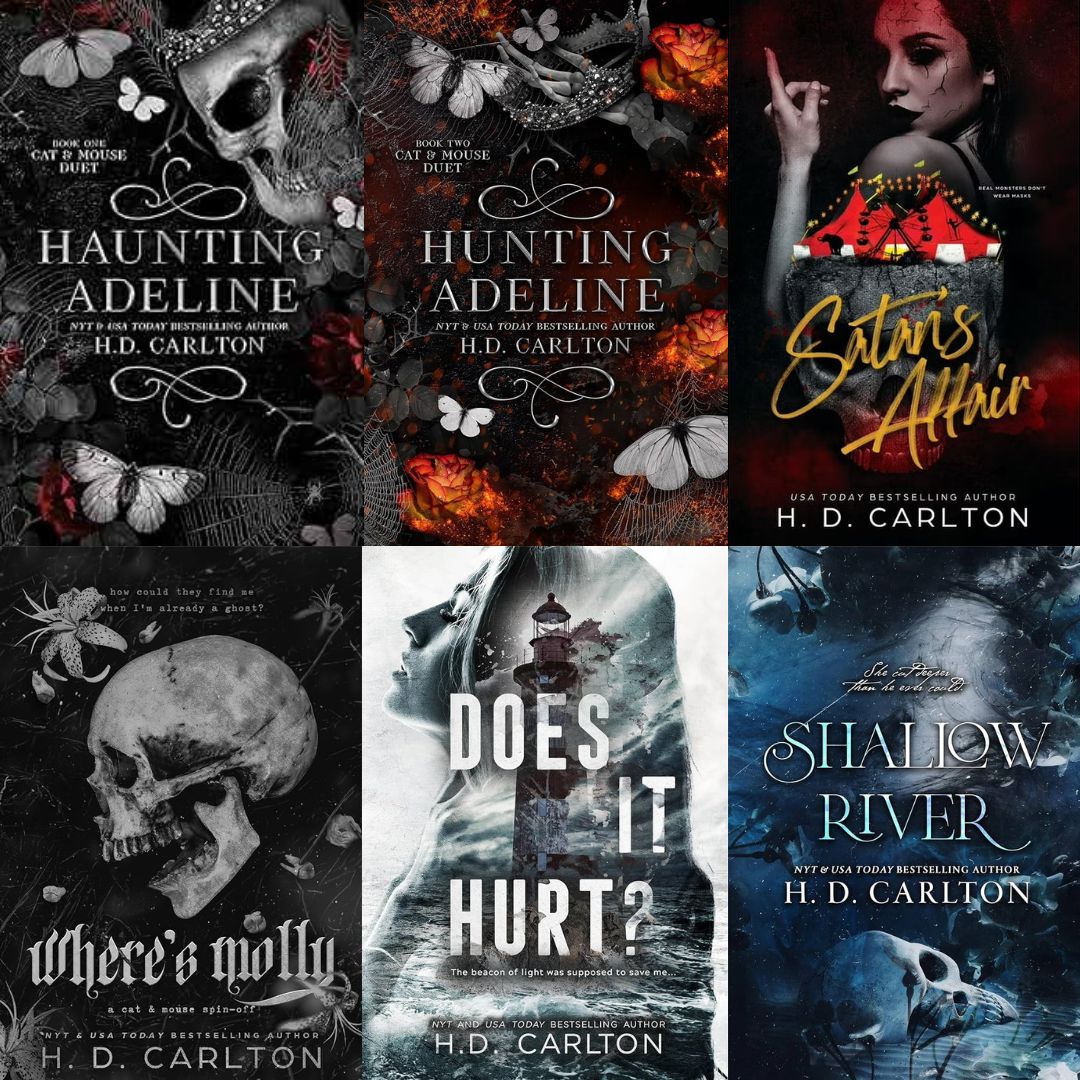
If you’ve found yourself searching for H.D. Carlton books, chances are you’ve already encountered her in the wild.
Usually through Haunting Adeline.
That tends to be the gateway drug. Someone on TikTok loses their mind over Zade, someone else loudly declares the book an affront to God and feminism, someone in the comments says it ruined their life in the best way, and before you know it you’re three chapters deep wondering whether this is the worst thing you’ve ever read or the most addictive.
Often, quite inconveniently, it’s both.
That is really the first thing to understand about H.D. Carlton as an author. She does not write books people feel normal about.
She’s polarising. Her books turn readers into rabid fans or outspoken denouncers. Readers either devour in a state of horrified fascination or fling across the room in disgust. There is very little middle ground. And that, more than anything, is why so many people go looking for books by H.D. Carlton the second they finish one.
Love her or hate her, she leaves an impression.
But, if you’re here it’s either because you want the full list of H.D. Carlton books so you can Pokemon them, or you’re lost trying to figure out the correct reading order. If you’ve read the Cat and Mouse duet and have finally stopped staring blankly at the wall long enough to wonder “But…what do I read now?!” the answers are here.
Welcome to everything you need to know about H.D. Carlton and her disturbingly unputdownable yet deeply disturbing books.
@briarblackbooks I’m obsessed. I’m addicted. To HD Carlton… and pretty much all Dark Romance 🖤 Welcome to the shelf, Zade Meadows 🥵 Thanks you @fabriCo he’s perfection 😍🖤 #HDCarlton #HauntingAdeline #HuntingAdeline #DoesItHurt #ShallowRiver ♬ original sound - 𝙢𝙧𝙨𝙬𝙖𝙧𝙣𝙚𝙧𝙧
So, Who Is H.D. Carlton?
H.D. Carlton is one of the biggest names in dark romance right now, though ‘dark romance’ almost feels like too neat a label for the unhinged mayhem this woman crafts.
Yes, technically that’s the shelf these books sit on, but her work tends to bleed into psychological thriller, dark romantic suspense, survival horror, trauma narrative, and the general category of books that make readers stop and say, “I know I shouldn’t be enjoying this, but I can’t put it down.”
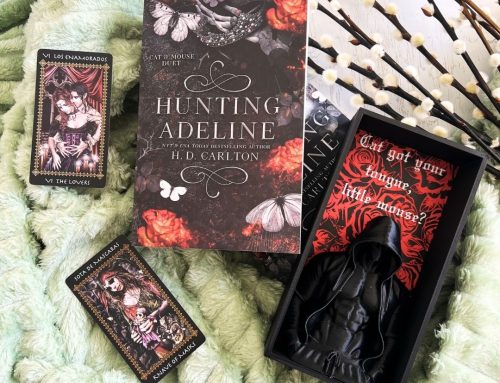
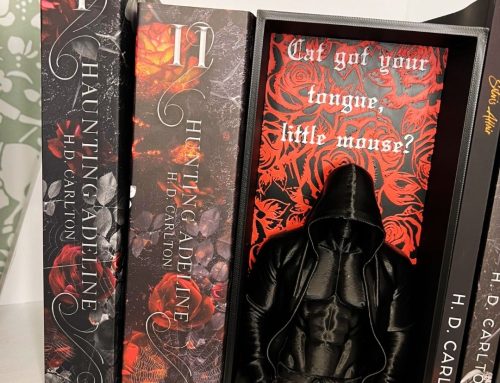
That was certainly my reaction when I first read Haunting Adeline. Now I own every book she’s ever written in physical and audio form, and just ordered some (very expensive, oops!) special editions of the Cat and Mouse Duet.
That “This is so bad it’s delicious give me more!” reaction?
Total normal for these books.
That’s H.D. Carlton’s magic trick.
A lot of authors can write taboo. A lot of authors can write spice. A lot of authors can write possessive men and call it dark. Carlton’s particular talent is that she writes intensity in a way that feels genuinely destabilising. Almost debasing.
Her books don’t just flirt with discomfort. They move in, unpack, and start rearranging your moral furniture.
That’s why her readership is so obsessive. It’s also why the backlash is so loud. She’s writing in a corner of the genre where the fantasy gets dark enough that readers start arguing. Not just about whether the books are good, but whether they should work at all.
Often, infuriatingly, they do.
H.D. Carlton’s Books in Order
Now for the bit everyone insists on making more complicated than it needs to be.
If what you want is the simplest possible answer to what order to read H.D. Carlton’s books, here it is:
- Haunting Adeline
- Hunting Adeline
- Satan’s Affair
- Where’s Molly
- Phantom
Then, outside that universe:
- Does It Hurt?
- Shallow River
That said, this is one of those situations where the exact phrasing matters. The real core reading order, the one that actually matters, is Haunting Adeline followed immediately by Hunting Adeline. Everything else branches outward from there.
That’s the duet. That’s the centre of gravity. That’s the reason most people know her name.
You can absolutely make a case for Satan’s Affair first if you’re being very technical about the wider universe, but I think for most readers that’s overcomplicating what should be a very obvious starting point. If someone lands on this page because they’ve heard of H.D. Carlton and want to know where to begin, the answer is not “well first you should read the creepy little side novella.” The answer is Haunting Adeline. That is the book that built the obsession, created the discourse, and made readers go feral.
Once you’ve read the duet, then it makes sense to expand.
Where’s Molly is very clearly something you read after the main pair, because it grows out of one of the darkest threads in the story. Satan’s Affair becomes much more interesting once Sibby stops feeling like a deranged side note and starts reading as someone with genuine narrative weight.
Phantom is the awkward one. It’s technically the prequel to the Cat and Mouse Duet, but in practice I would never hand it to a new reader and say “Start here”. It may be chronologically first but reading it first will ruin the central mystery that makes Haunting Adeline such a layered read.
So yes, there is an official-ish order floating around. But the practical reader’s answer is simple: duet first, universe second, standalones whenever you like.
Where Should You Start With H.D. Carlton?
This depends entirely on why you’re here.
If you want the books H.D. Carlton is actually known for, start with Haunting Adeline. That is the obvious entry point, the most famous title, and the one that tells you very quickly whether this author is for you.
If you finish it and feel morally compromised but weirdly compelled, congratulations.
You are exactly where she wants you.
Read Hunting Adeline immediately.
If, on the other hand, you’re intrigued by H.D. Carlton because you’ve seen so much about her online, but not sure you want to leap straight into the deepest, filthiest, most controversial end of the pool, then one of the standalones may be a better place to begin.
Does It Hurt? in particular has a very different flavour.
It’s still dark, still intense, still not remotely wholesome, but it isn’t carrying the same weight of online discourse as Cat and Mouse.
Shallow River is also a standalone, though thematically it leans into trauma in a way that makes it its own kind of rough ride.
Personally, though, I think if you’re coming to H.D. Carlton at all, you’re probably coming for the thing she’s famous for.
And that means the Adelines.
Honestly I started there. Not just with H.D. Carlton but with dark romance as a whole. Haunting Adeline was the first dark romance I ever read, and I’m now so hooked I’ve run out of shelf space and started writing a dark romance of my own.
Why H.D. Carlton Works So Well For Some Readers
This is where it gets interesting, because on paper I should have a much easier time dismissing some of these books than I do.
And yet.
Carlton understands compulsion. That’s the key. She knows how to write stories that create a kind of narrative chokehold. Her books are not elegant in the traditional sense.
They are not restrained.
If you’re looking for beautifully written romance or literary brilliance, these books aint it.
They are not subtle little meditations on love and desire. They are full-throttle emotional chaos. Obsession, fear, power, violence, need, trauma, possession, taboo, and enough sexual tension to make you feel faint or homicidal depending on your mood.
She weaponises intensity.
That’s why people get so hooked. You’re not reading H.D. Carlton because you want a healthy relationship model and a nice afternoon. You’re reading because you want to feel slightly deranged.
You want the push-pull of being appalled by what’s happening while still needing to know what happens next. You want a book that will make you text your friends things like, “I know this is terrible but I cannot stop.”
And to her credit, she delivers that better than most.
The H.D. Carlton Controversy: Why Are People So Divided?
Well. Because the books are controversial.
Genuinely controversial, not “the internet got bored and picked a target” controversial.
A lot of the criticism surrounding H.D. Carlton, especially Haunting Adeline, comes down to consent and how sexual violence is framed within the story. There are readers who feel the book crosses so far into non-consent that it ceases to function as dark romance and becomes something much uglier. There are readers who think the fantasy framework is obvious and that adults are perfectly capable of understanding the difference between transgressive fiction and real-world endorsement. There are readers who fall somewhere in the middle, which is usually the most uncomfortable place to be, because that’s where you end up admitting that something can be deeply questionable and still weirdly compelling.
That’s part of why the book has had such a grip on people.
Then there’s Zade, who may be one of the clearest examples of a character readers either categorise as dark anti-hero or stare at in disbelief while everyone else thirsts after him. He’s often described as morally grey, though depending on your tolerance for fictional men doing absolute nonsense, you may feel that term is being stretched beyond all useful meaning.
There is a huge difference between “morally grey” and “this man is a walking crime spree with abs”.
H.D. Carlton likes to live right on that fault line.
The wider trafficking plot of the Cat and Mouse Duet has also drawn criticism, particularly where readers feel it edges into conspiracy-coded territory. That’s another reason the backlash hasn’t gone away. These books aren’t controversial solely because they’re explicit. They’re controversial because they tangle sexual violence, vigilante fantasy, abuse, obsession, and a very particular kind of dark-romance framing in ways that invite readers to argue about what the author is actually doing.
And then, of course, the controversy feeds the popularity. People hear the book is shocking, so they read it to see what the fuss is about. Then they either get hooked or horrified, and either way they talk about it. Which means more people hear about it. Which means more people read it. It’s basically a cursed little ecosystem.
(If you want more deets on all this, I’ve dug a bit deeper into it in my review of Haunting Adeline.)
A Quick Word On Content Warnings
I go much harder on this in individual reviews, but if we’re talking broadly about H.D. Carlton books, the short version is that these are not books you wander into blind and then act surprised by.
Her catalogue includes stalking, rape, coercive control, trafficking, torture, captivity, abuse, psychological trauma, and generally the sort of material that earns the phrase “check the trigger warnings” in big flashing neon letters.
This is not dark romance in the “he’s a bit possessive and has a deep voice” sense.
This is dark romance in the “you may need to stop and reassess your life choices halfway through” sense.
That isn’t me condemning the books. It’s me being honest about what they are.
H.D. Carlton’s Audiobooks
We also need to talk about audiobooks, because they’re very much part of the experience for a lot of readers.
And yes, I’ll say it plainly: H.D. Carlton audiobooks are a particularly rare treat.
Teddy Hamilton voicing Zade is honestly just delicious.
There is simply no dignified way to phrase that, so I’m not going to try.
The audiobooks heighten books that are already teetering in the stratosphere. Like i said, Haunting Adeline was the first dark romance I ever read. And I ‘read’ it on audio first.
On a plane.
While sitting next to strangers.
That was deeply uncomfortable for so many reasons, but I devoured that book so fast. I listened the whole flight. And the transfer bus ride to my hotel. And very late into the night until I finally finished.
The result being a very sleep deprived Briar stumbling around the pool the following moring.
So worth it.
Carlton’s books are excessive on the page. But with the right narration that intensity becomes even more unhinged. The wrong line can go from cringe to filthy to weirdly compelling depending entirely on the delivery, and Teddy Hamilton has exactly the kind of voice that makes Zade work far better than he has any right to.
That said, audio is also where some of the edition chatter gets messier. More immersive or dramatized productions are not universally loved, because once you start layering in music and extra effects, some readers find it atmospheric and others find it distracting as hell. So, I’d sample first.
When it works, it really works.
When it doesn’t, you’ll know quickly.
Cat and Mouse vs the Standalones
One thing worth saying, because it gets lost in the discourse a bit, is that not every H.D. Carlton book is trying to do the same thing.
The Cat and Mouse books are the phenomenon.
They’re the books that generated the obsession, the backlash, the fan edits, the moral panic, the ravenous fandom, and the endless think pieces about whether enjoying them makes you part of the problem or just a reader with a functioning ability to distinguish fantasy from reality. They are operatic in their chaos. Excessive. Addictive. Often absurd. Very difficult to ignore.
The standalones, by contrast, feel less like an entire internet event and more like individual exercises in dark romantic suspense. That doesn’t make them tame. It just makes them different. If you’re curious about Does It Hurt or Shallow River, you’re probably either already sold on her voice and looking for more, or you’re trying to work out whether the rest of her catalogue is all Cat and Mouse-style madness.
The answer is no, not exactly.
The darkness is still there, but the flavour shifts. Which is a good thing. A whole backlist that felt identical would be exhausting.
What Else Has H.D. Carlton Written?
If you’re here from Haunting Adeline or Hunting Adeline specifically and just want a plain-English answer to what else this woman has written, the key titles to know are
- Does It Hurt?
- Shallow River
- Satan’s Affair
- Where’s Molly
- and Phantom.
Before Cat & Mouse, Carlton wrote an earlier duology (Hollow and Untainted), but these have since been pulled and aren’t part of her current catalogue.
Looking forward, there’s a new duology on the way (My Dreadful Darling and My Darling Reverie), along with multiple planned expansions in the Cat & Mouse universe, including books for Sibby, Rio, and the Basilisk Brotherhood.
If you’re the kind of reader who likes following an author as their universe expands, she’s very much one to keep an eye on.
Final Thoughts On H.D. Carlton’s Books
H.D. Carlton is not an easy author to recommend.
That, I suspect, is a large part of the appeal.
She writes books that are messy, morally combustible, often deeply uncomfortable, and yet somehow still wildly readable. Her catalogue is uneven in places, but when she hits, she really hits. The Cat and Mouse duet in particular has become such a huge talking point because it taps into something readers can’t seem to resist arguing about: where fantasy ends, where taste begins, what we’ll accept in fiction, and why some books become impossible to look away from even when we know perfectly well they’re a terrible idea.
So if you came here trying to figure out what order to read Carlton’s books in, the short answer is simple. Start with Haunting Adeline. Then read Hunting Adeline. After that, branch out into the connected books or the standalones depending on what you want more of.
If you came here wanting to know whether Carlton’s books are actually worth reading, the honest answer is more annoying.
If you like dark romance, high-intensity obsession, morally dubious men, and books that make you feel like you should perhaps be judged a little for enjoying them, then yes.
There is absolutely a reason this author has such a huge readership.
Just don’t expect to come away from her books feeling normal about any of it.




 4.28 Average