Skip to content

Rating: ★★★★★
Genre: Dark Romance / Gothic Romance
Available On: Amazon
A young woman, snatched from the edge of death after war rips her whole world apart. She’s remade, immortal, and given the chance for instant vengeance. But what happens after you’re saved? When the bloodlust for those that murdered your family is sated, but your lust for blood never fades?.
When you never age, or die.
For centuries, Constanta belonged to the man who saved her as they wandered Europe experiencing plagues, and wars, and changing eras, collecting beautiful people to feed on, or bind to him as part of their strange coven.
Bound together by blood, desire, devotion.
Control.
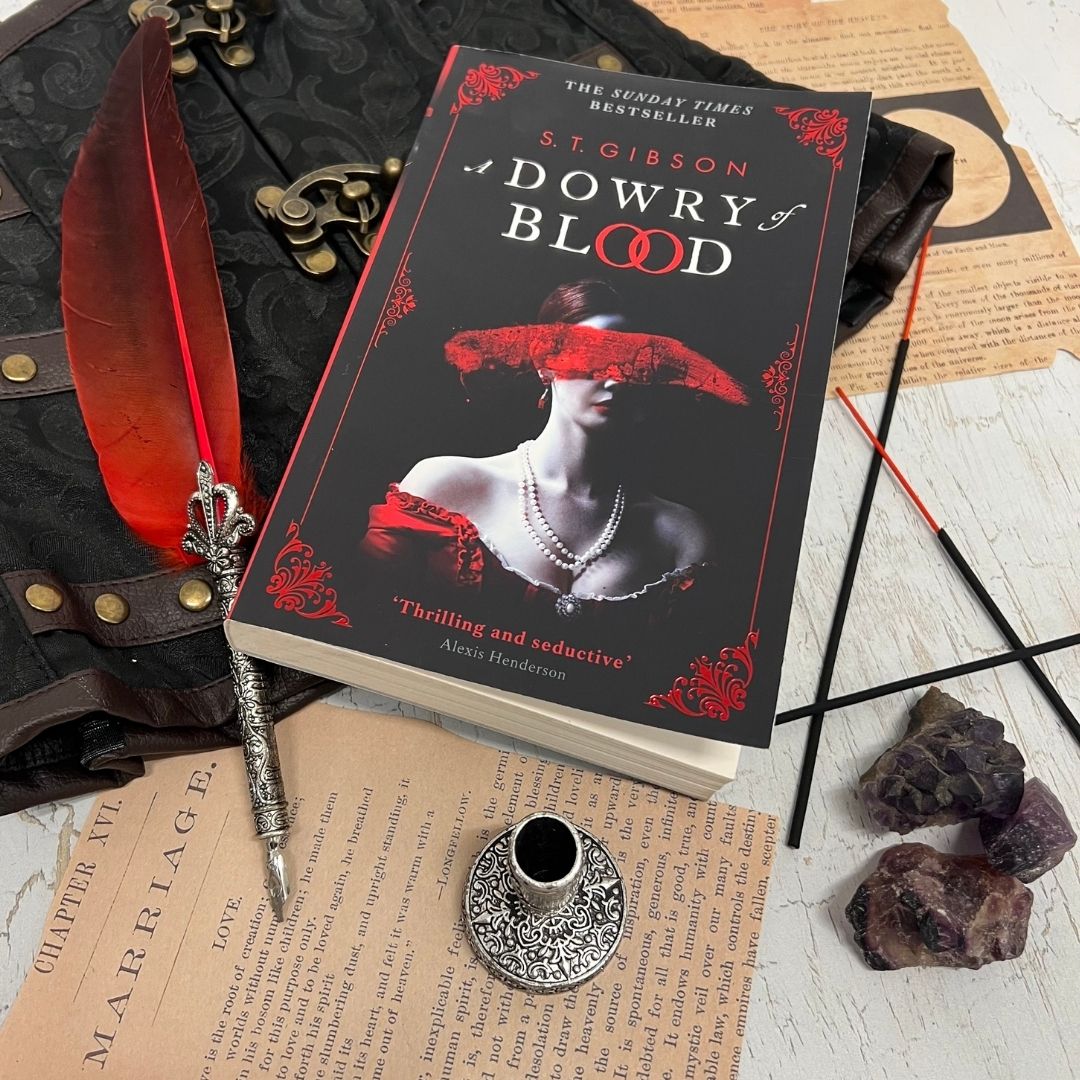
A Dowry Of Blood by S.T. Gibson is a Gothic Romance, told retrospectively, as Constanta looks back over the impossibly long life she’s lived and the relationship that shaped it. The scope is vast in time and place, yet the narrative never strays far from the intimate orbit of its central coven.
At its core, this is a gothic dark romance, and a character study about love, dependency, and what it costs to finally step out of someone else’s shadow.
Retelling Dracula…Or Is It Lestat?
I’ve seen A Dowry Of Blood billed as a Dracula retelling. And there are undeniable parallels — a powerful vampire, multiple enthralled brides, centuries of manipulation. Reading it though, it felt closer in spirit to Interview with the Vampire, but in a very specific, very indirect way.
This is not a plot-driven gothic romp. It is a confession.
From the opening pages, we are told that Constanta has killed her sire. We are not told his name. We are not even told her true name, only the name he gave her. There’s no mystery about how this will end. The tension doesn’t lie in the question of if she ends him, but why she’s eventually driven to it.
And what it costs.
The entire novel is framed as a letter to the man Constanta murdered. A love letter. An accusation. A justification. And, in some strange, unsettling way, an apology.
Sort of.
It is not “I’m sorry I killed you.”
It’s “I’m sorry you left me no choice but to kill you.”
@briarblackbooks Lyrical, almost archaic prose. Echoes of Interview With A Vampire, but deeply unique. Sapphic / bisexual / polyamorous rep. I’m so obsessed with A Dowry Of Blood 🩸
♬ son original - 𝐅𝟒𝐧𝐭𝐚𝐬𝟕𝐚
The Narcissist’s Non-Apology
The book uses vampirism as a metaphor for coercive control and psychological abuse, and this framing device is one of the most fascinating narrative choices I’ve seen in a long time. Having survived an abusive relationship myself, I’m painfully familiar with the narcissist’s non-apology:
“I’m sorry you feel that way. You’re wrong to feel that way. Don’t feel that way next time.”
They’re not sorry they hurt you. They’re sorry you inconvenienced them by being upset about it, and warn you not to let it happen again. Because there will be a next time. And you’d better not be so upset again.
It’s tedious.
Constanta’s unnamed ‘Lord’ perfectly embodies that entire vibe. I found it viscerally unpleasant to witness, but also incredibly cathartic.
There’s something deeply healing about books that expose your trauma in all its deep, messy, technicolour glory. Pleasant to read? No. Necessary to disavow people of the notion this sort of behaviour is in any way acceptable?
Absolutely.
Constanta’s recounting of her centuries with her sire makes it clear why she did what she did.
There’s very little argument to be made that he didn’t deserve it. And yet she frames the entire story as a sort of apology. The kind that is hollow in words and thoroughly unapologetic in spirit.
It highlights something ugly and deeply real about surviving abuse: the way it warps your thinking, normalises gaslighting and manipulation. Leaves you compelled to justify yourself to the person who hurt you, even after you’ve escaped them, because somewhere deep inside you’re still terrified of their wrath.
More than that, Constanta’s refusal to apologise for the actual act that brought harm, and the way she reframes it as his fault for forcing her to do it, is eerily familiar.
The difference, of course, is that her violence was an act of protection, of love. For herself, yes, but more so for others.
She genuinely regrets that it came to killing him. She wishes it hadn’t.
But she would do it again, because he left her no choice. The narcissist who’s been called out for hurting you will insist it’s actually you victimising them. And that’s horseshit. But for Constanta, it’s true, and a dark mirror held up to the true cost of staying with a person who treats you this way.
Detached, Disjointed, Deliberate Narrative Style
A Dowry Of Blood doesn’t serve a conventional narrative. Everything is told retrospectively. Constanta is explaining a life already lived, rather than allowing us to experience it alongside her in real time.
Because of that, the pacing is strange. Intentionally.
The plague passes in a few sentences.
A few moments can stretch across pages.
Centuries slide by in broad strokes. A glance, a betrayal, a wound are rendered in exquisite detail. The result feels less like a plotted novel and more like memory itself. Most of us don’t recall every detail of our lives. We remember the gist of a time, a place.
Only pivotal moments remain in technicolour.
That’s exactly how this book reads.
In lesser hands, this structure could have been frustrating. What saves it, elevates it, is the prose.
The writing is exquisite. Slightly archaic, but in a beautiful way, rather than being tough to read. Constanta has lived through ages, and she tells this story from a relatively modern vantage point, which allows her voice to feel authentic without being alienating. She’s not remained in the voice and time she was born to. So while her voice feels ancient, she’s grown through time and adapted.
It carries the weight of centuries without feeling like you’re reading Beowulf.
Reading it felt like listening to beautiful music. And while many authors manage lyrical prose, few manage an entire novel that feels like an aria.
It will not be to everyone’s taste. It is slow. There is very little plot in the traditional sense.
But plot isn’t the point.
This is a psychological excavation, not an adventure.
Abuse, Discomfort, and Why It’s Meant to Hurt
This is a tough read in places. It should be.
You can’t explore psychological abuse from the internal perspective of the victim without forcing the reader to sit in discomfort. The control, the gaslighting, the slow erosion of identity are not romanticised.
They’re intimate. And suffocating.
Some readers will find that unbearable. Others will find it validating.
The novel does not rush toward catharsis. In fact, I found the ending slightly underwhelming on first read. I was waiting for something bigger. A sharper climax. A final, explosive moment.
It didn’t come.
But the more I thought about it, the more I understood that choice. Abuse does not end in operatic fireworks.
It usually ends in brief flashes of violence, or quiet exits.
Real life rarely offers sweeping catharsis. For Constanta’s story to end the way it does (and it’s frustrating in its restraint) is painfully true to the subject matter.
Effortless and Refreshing LGBTQ+ Representation
By far the strongest element of this book is the presentation of sapphic and bisexual characters within a polyamorous dynamic that simply exists.
It’s not dissected. It’s not justified. It is not framed as radical.
It just is.
Women love women. Men love men. Everyone sleeps with who they want in as many combinations as they want. And none of it is treated as lesser or secondary to heterosexual love.
This is rarer than people think. Even books that market themselves as queer often foreground queerness as conflict, as identity crisis, or inadvertently centre straight relationships as more significant.
There is none of that here.
It’s seamless. It’s natural. It’s refreshing.
A Surprisingly Spicy Tale
A Dowry Of Blood is surprisingly spicy for a book that echoes classic narrative style. And yet, the spice mirrors the narrative structure. Some encounters are explicit and vivid. Others are blurred, half-remembered, deliberately glossed over, occasionally verging on fade-to-black.
That feels entirely in keeping with a retrospective confession. Some moments remain seared in Constanta’s memory. Others dissolve. Some are avoided.
If you’re going in expecting constant high heat, that’s not what this is. If you’re expecting high-octane action, adventure, and violence, this is not that either.
But if you go in understanding what it isn’t, you’re far more likely to appreciate what it is.
A Dowry Of Blood is slow, introspective, psychological, and beautifully written. It prioritises feeling over plot, atmosphere over action, memory over immediacy.
It’s not going to be for everyone.
But for the right reader, who’s willing to sit with discomfort so they can examine the anatomy of coercive love, and appreciates language that feels like music, this book is extraordinary.
It’s my first five star read of the year, and I’ll definitely be re-reading at some point.
My only caveat: know what you’re picking up before you open it.
This is a stunningly beautiful, sapphic, inclusive, elegant exploration of one of the ugliest sides of love. It’s told through a classic metaphor, dressed in gothic drama and atmosphere, with deliciously spicy moments and seriously uncomfortable ones existing so close together you occasionally can’t tell which is which.
Sublime.








 4.28 Average