Skip to content

Rating: ★★★★★
Genre: Romantasy
Available On: Amazon & Audible
Spoiler warning: I’ve tried to avoid major spoilers but be aware, this Daughter of No Worlds review discusses major early plot points and thematic developments in the book.
Happy to read on? Good.
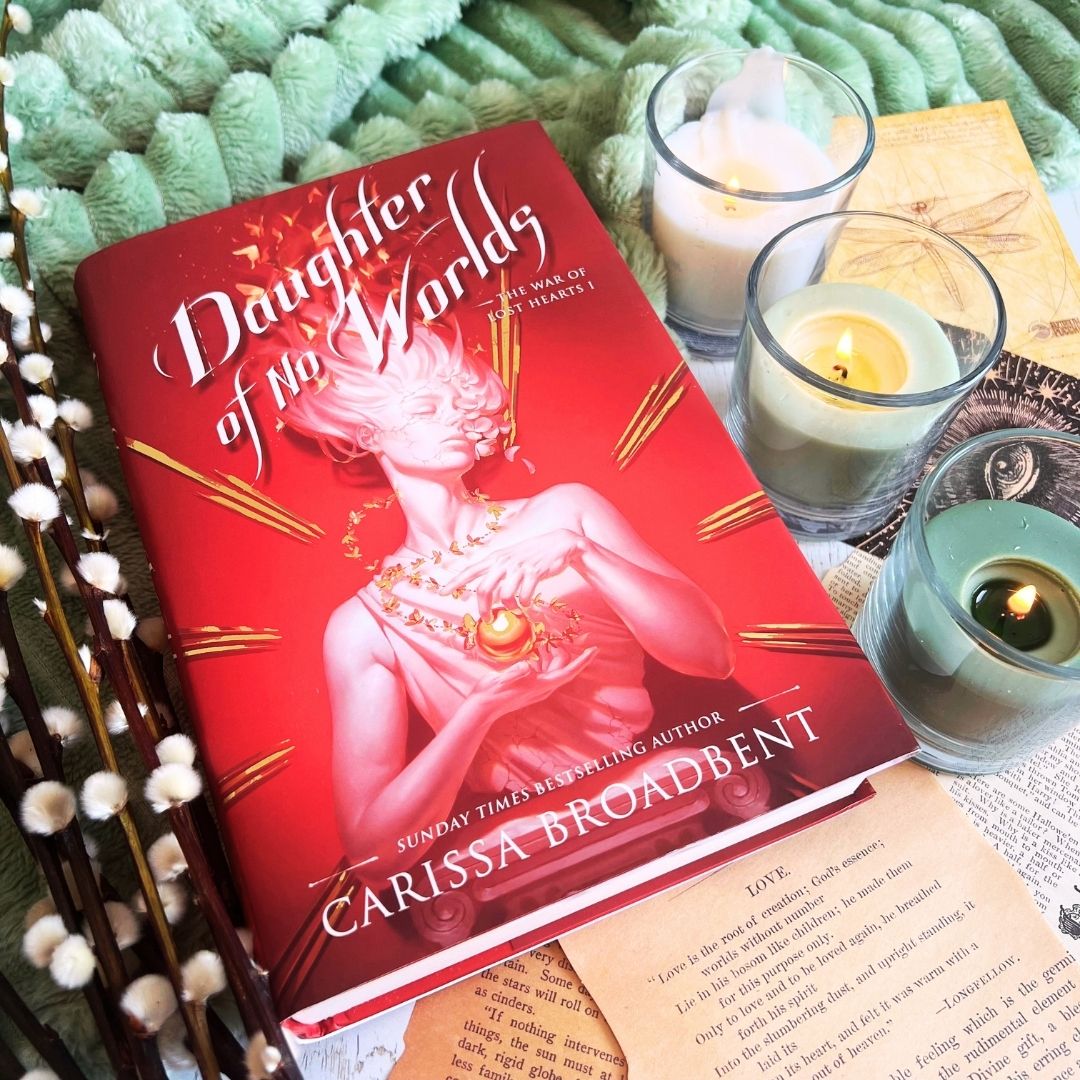
Daughter of No Worlds by Carissa Broadbent is not the romantasy to pick up if you want instant lust, a morally grey shadow daddy growling in your ear, high spice every few chapters, and a heroine whose trauma exists mostly to make the kissing a bit more feral.
Not that I’m opposed to a good shadow daddy. I’m not in the slightest. Sometimes the mood calls for wings, emotionally repressed sarcasm, violence, questionable decisions, and a man who treats communication like an enemy nation.
But Daughter of No Worlds is doing something different.
This is a slower, more thoughtful fantasy romance about trauma, survival, bodily autonomy, power, freedom, and the cost of moving from being a person things happen to, into becoming someone actively choosing and shaping what comes next. It’s romantic, deeply romantic, but the romance isn’t the only heart beating throughout the book. Politics, magical systems, rebellion, physical and emotional trauma, and psychological exploration all get space. Sometimes beautifully. Sometimes too slowly. But usually with enough emotional intelligence to make the waiting worthwhile.
Daughter Of No Worlds Synopsis
Daughter of No Worlds follows Tisaanah, a young woman taken as a slave as a child. Ripped away from her family and everyone she knew, and forced into a life of violence, exploitation and obedience, Tisaanah has spent years surviving under her master’s control, clinging to one fragile promise: if she can save enough coin, she can buy her freedom.
But she doesn’t plan to take her freedom and quietly disappear into a life of safety.
Tisaanah is Fragmented: born with Valtain blood and magic, but not fully Valtain. Her largely colourless, mottled skin and hair, along with her mismatched white and green eyes, visibly mark her as rare and useful, but also lesser.
While her power has never been properly trained, Tisaanah met a Valtain, Zeryth Aldris, years earlier, who told her that if she could make it to Ara, he could help her gain membership to the Orders.
Tisaanah believes that if she can join the Orders and learn to properly control her magic, she can become powerful enough to return to Threll and free her people. She just needs to save enough coin to buy her freedom and passage to Ara. The book begins as she gains the final coins she needs and goes to claim the freedom her master promised.
Very predictably, because men with power and delicate egos are apparently a cross-world infestation, that promise is a lie.
When Tisaanah presents the money she’s spent years gathering, her master refuses to free her.
Owning slaves was never about money. It was about power. Her attempt to take that power back results in a brutal, near-fatal whipping. In the middle of that violence, Tisaanah’s magic lashes out in a way she cannot fully control.
She kills him.
From there, she escapes to Ara, determined to join the Orders and gain the power and political backing needed to return home and free the people she left behind. To do that, she needs training. Unfortunately, the person assigned to train her is Maxantarius Farlione, a reclusive, traumatised former war hero who wants absolutely nothing to do with the Orders, politics, war, students, hope, ambition, or people in general.
Naturally, this goes terribly for his peace and quiet.
Max was not made for this.
As it turns out, though, he’s oddly perfect. Once he reluctantly agrees to train Tisaanah, the novel explores her training, her discovery of Ara’s political and social landscape, and the revelations about the troubles surrounding Sesri, Ara’s child queen, as well as a brewing war, political intrigue, and the ways magic is being used and abused by everyone.
Tisaanah, Trauma, And Over Sanitisation
One of the reasons Daughter of No Worlds works as well as it does is Tisaanah herself, though I did initially feel she had been weirdly sanitised considering everything she’s been through.
This is a girl taken as a slave as a child, who watched her entire family and everyone she knew sent to the mines where they are presumably dead. She becomes a dancer and sex slave to her master, and we know she prostituted herself once for money. There may have been further sexual exploitation beyond that. She is physically abused and mentally conditioned to believe that despite her horrendous treatment and everything she’s been through, she’s ‘lucky’.
That is a huge amount of trauma for one character to carry.
And yet, at least at the start, there were moments where she felt weirdly fine for someone who’d endured so much. She has anger. Determination. A survival instinct. But for someone who’s lived through that much control, brutality and sexual violence, she sometimes feels almost too functional, too heroic, too neatly pointed toward liberation as a goal.
I don’t mean I wanted endless suffering-porn or a heroine so broken she can’t make a decision without collapsing dramatically on some hunky man’s shoulder.
Absolutely not.
But there is a difference between writing a survivor with agency and sanding down the messier psychological consequences of trauma because the plot needs a noble, brave, appealing heroine.
That’s where the opening left me a little conflicted.
The premise is simultaneously intriguing, devastating and slightly underwhelming.
Tisaanah has constructed this whole scenario in her head where the people she lost sacrificed themselves to save her. To give her a chance. And she must find a way to make that sacrifice worth it.
She’s holding onto this blind hope she can one day repay that debt by becoming something and doing something that improves the situation of those like her and all the people she lost.
That’s tragic. It’s deep. It’s also just a touch contrived and unbelievable.
Given everything she’s been through and seen, Tisaanah’s belief that her master will honour the promise to free her feels naive in a way that initially strained belief for me.
Then you remember everything she’s endured was an actual lived experience for this girl, something she had to survive, and the whole thing clicks into a far sadder shape.
Her hope is not rational. It’s survival.
It’s the only thing keeping her upright.
She needs to believe freedom can be bought because the alternative is admitting there was never a way out.
That is where the book started to win me over.
The Gold Coin Problem, Because Apparently I’m This Person Now
While I’m on the subject of things that tripped me up at the start, I do need to pause for the 1,000 gold coins situation because, no.
Let’s ignore for a moment the completely ridiculous notion that a slender girl could hoist 1,000 gold coins anywhere, with any kind of ease, let alone physically conceal them in her small slave quarters for years while they accumulated without anyone knowing about it.
Actually, no. Let’s not ignore that. Let’s drag that out into the harsh light of day and call it what it is: logistical nonsense.
Fantasy asks us to believe in magic, magical orders, magical wars, invisible scars, murder ghosts, supernatural possession, and occasionally men who communicate clearly. Fine. Lovely. I accept the dragons. I accept the cursed objects. I accept the ominous ancient power having a dramatic name.
But 1,000 gold coins hidden in slave quarters without discovery?
My suspension of disbelief did briefly set down its peppermint and liquorice tea and stare blankly into the middle distance.
That said, the emotional function of the coins works. Because it’s not really about the coins. The point is the false promise. The horror of realising the system Tisaanah is trapped in was never transactional.
Never equal.
Tisaanah thinks she has been working toward a price. Her master, the Threllian Lord Esmaris Mikov, named that price: 1,000 gold coins. She saved the money, she goes to make the deal, only for Esmaris to reveal she was never in a position to negotiate with him. He’s not a businessman with whom she can trade.
He owns her.
And her value to him is not measured in gold coins, but power. Control. The ability to lord it over a girl he lusts for. To force her into a position of powerlessness, and take what he wants when he wants it, all while convincing her she’s ‘lucky’ to be his. Because she’d have it far worse elsewhere.
No amount of coin could convince Esmaris to relinquish the power owning Tisaanah grants him. And that revelation destroys the final shred of autonomy Tisaanah had clung to: the belief that if she could meet the price he named, her value could become leverage, and that leverage could buy back her freedom.
But freedom isn’t transactional. Slavery isn’t about money.
Money is a byproduct of the desire for power, and the use of human collateral to build and wield that power.
The powerful do not relinquish the thing that gave them power without a fight.
Magic, Violence, The Question of Control
The moment Tisaanah kills her master the book becomes much more interesting.
Until then, her magic has mostly been used to make pretty butterflies and improve her performances. It has been decorative, controlled, pleasing. A thing that makes her more valuable to the people using her.
As Esmaris beats her close to death, it becomes lethal.
What I found compelling is the grey area around whether she actually does it intentionally.
She is being whipped. He’s not stopping. Her body understands she is going to die if something does not intervene. Her magic lashes out.
So is that murder? Self-defence? Instinct? Choice? A power she commands, or a power that finally refuses to let her be killed?
That becomes one of the strongest themes in the novel: control, bodily autonomy, and how much the acts we are driven to in order to achieve noble ends through horrific means are conscious choice versus instinct.
This is where Daughter of No Worlds has more going on than a lot of romantasy. The book is not just asking whether Tisaanah can become powerful. It is asking what power means to someone whose body has never fully belonged to her. That thread is also echoed later through Maxantarius’ arc and the nature of the magic that eventually binds them together.
Both Tisaanah and Max deeply regret the violence they were driven to in the past, yet both later choose violence.
When Tisaanah fights for liberation, and Max joins her in that mission, the question becomes more complicated. They are both moving past survival, trauma, and grief over what they’ve lost and taking control of their choices again, only to find they may choose to do more of the same in order to protect and defend those they love from suffering their own original fates.
They mirror each other. Different trauma, different responses, same impossible choice: do more of what broke you in order to rid the world of the original sin.
That’s way more interesting than ‘hot magical girl discovers she can kill people, looks great doing it, and picks up a morally grey menace to assist while they have lots of spicy sex’.
Why The Trauma Works Better As The Book Goes On
I wasn’t fully sold at the start of the book, but I’m very glad I persevered.
Tisaanah’s trauma becomes more layered as we get to know her, even as she’s layering more trauma on top of it with everything she goes through. The longer the book sits with her, the clearer it becomes that her hope is not simple optimism.
It’s debt. Grief. Survivor’s guilt masquerading as ambition.
She does not just want freedom because freedom is morally correct, although obviously it is. She wants freedom to mean something. She wants her survival to retroactively justify everyone else’s suffering. She wants to believe that if she can liberate others, then the fact she lived when they didn’t will become bearable.
And again, this thread is echoed in Maxantarius’ journey, trauma, processing, and guilt.
That is a much more nuanced emotional engine than “I was hurt, therefore I will become badass.”
And honestly, thank god.
There are only so many supposedly fierce heroines I can read before they all start to blur into one knife-wielding ball of sassy trauma, sarcastic takedowns, and improbably tight leather ‘fits.
Tisaanah is more interesting because her strength isn’t swagger. It’s endurance and purpose. The ugly, desperate belief that if she keeps moving, it just might all eventually mean something.
Maxantarius Farlione Is Not A Shadow Daddy. That’s The Point
Max is introduced reasonably early and presented for about half a second as a wise mentor figure before you clock that, actually, he’s a lot younger than that. And, actually, he’s only a few years older than Tisaanah. And, actually, his grumpy surliness and antisocial behaviour are masking his own deep, deep pain. And, actually, he’s really fucking hot.
And actually, he needs her just as much as she needs him.
Not in a romantic way at first, but in the sense that he has lost all sense of purpose or meaning in his life and is just wasting away to nothing as the weight of all his regrets crushes him.
Then in walks Tisaanah. A girl who has been through impossible things and yet still stalks about the place demanding everyone help her liberate her people. Somehow, impossibly, she believes this is actually a reality she can make happen if she just works hard enough for it.
And she infects him with her weirdly blind hope.
That is the real romance hook for me. Not instant attraction. Not possessive growling. Not ‘touch her and die’ theatrics, though I do enjoy those when I’m in the mood for that sort of thing.
But the hook here isn’t basic bat boy energy. Morally grey shadow daddy doing bad things for good reasons and looking like a delectable treat while doing it. That has a time and a place, and it isn’t this novel.
The hook is that Tisaanah forces Max to remember the possibility of meaning.
She allows him to see that perhaps he might still find meaning after everything too.
The Daughter Of No Worlds Romance Is A True Slow Burn
The romance in Daughter of No Worlds is a slow slow-burn in the best possible sense.
There is no insta-love here, no immediate attraction, no sudden “Oh no, he’s so hot my survival priorities have evaporated because he will defend me now.”
Tisaanah and Max begin as reluctant teacher and impossible student. Their relationship develops through training, frustration, trust, proximity, respect and the gradual recognition that they understand things in each other most people would rather look away from.
The best thing about the romance is that it feels like falling in love. Not blind attraction leading to hot sex that might eventually become real feelings. Actual, awkward, reluctant, fearful, slow burn in the pit of your stomach until the sight of him sets you on fire love.
Tisaanah does not look at Max and decide he is her answer. Max does not look at Tisaanah and reform his entire traumatised existence around her beautiful eyes, high cheekbones, and the way her eyes flutter when she comes for him.
They slowly become important to each other because they change the emotional weather of each other’s lives.
She gives him purpose. He gives her steadiness. She drags him back toward the world. He helps her understand the world beyond slavery. She forces him to care again. He gives her space to become powerful without trying to own that power himself.
It is tender without being saccharine, restrained without being cold, and beautifully romantic without reducing either character to a love interest without agency, choice, plot, motivation outside the other, or consequences.
The Delayed Max POV Is Genuinely Clever
One of my favourite structural choices is that we don’t get Max’s POV until we’re very far into the book.
For a long time, this is a first-person Tisaanah POV story. We know Max as she knows him: irritating, withdrawn, clever, powerful, evasive, wounded, occasionally kind, often infuriating. We are kept at the same distance she is.
Then suddenly, bam, we are in Max’s head and seeing his side of things.
But that only happens once Tisaanah has become comfortable and attached enough to him to let him in herself.
That was such a clever bit of narrative trickery. The book keeps us entirely within Tisaanah’s POV as she very, very slowly opens herself up to this man and allows him to see her, understand her, train her, form a tentative friendship, get frustrated and furious and badger him into helping her do something he no longer believes is possible.
Only when she has let her guard and walls down enough to let him be a person to her rather than just a means to an end does the narrative let him become a person to us too.
And by then, he in turn has opened himself to the possibility that, impossibly, this girl might actually force some kind of change for the better. Even if that change is minor. Even if it is not the grand plan of liberation she is outlining. It would still be worth coming out of hiding to help facilitate it, because any positive change is desperately needed, no matter how small.
Perhaps working together, it would be more than small change.
Perhaps it would actually matter.
And then we get to see his POV.
Only then.
I loved that.
The Middle Is Slow
The downside of enabling that slow-burn tension to truly develop at a gradual emotional pace is that the middle section of the book is pretty slow.
There is not much going on for a while beyond Tisaanah wrapping her head around her magic, learning how the world beyond her slavery actually works, and pushing against the limits of a political system that is far less heroic than she wants it to be.
I like training arcs. I like emotional groundwork. I like fantasy worlds where the politics matter and the heroine cannot simply stab one man and accidentally fix systemic oppression by dinner.
But there are definitely stretches where the pace sags.
The book is strongest when Tisaanah’s internal development, Max’s emotional withdrawal, the magic, and the wider liberation plot are all feeding each other. It is weaker when those strands feel like they are waiting in separate rooms for the plot to remember there is a door.
There are also some plot contrivances, especially around Max being ‘unable’ to just tell Tisaanah what happened to him or warn her of certain dangers. The obvious thing would be for him to straight-up explain stuff to her at more than one point, and he doesn’t.
Because if he did, the next part of the book just wouldn’t happen.
Fortunately, this is at least justified with a ‘He physically cannot tell her this stuff because MAGIC!’
Which, yes, contrived.
But it is far better than ‘He’s so repressed he didn’t know how to say it, or didn’t want her to know, so just didn’t mention it, then felt bad about it later!’
Which, honestly, is how a lot of these things go when the plot fairies need one character to remain in the dark about something when someone close could save them a lot of trouble with a quick explanation.
So yes, magical gag order.
A little convenient.
Still preferable to emotional constipation pretending to be narrative tension.
Daughter of No Worlds Worldbuilding Is Good, But Imperfect
The worldbuilding in Daughter of No Worlds has enough weight to make the story feel bigger than the romance. It’s not a decorative fantasy backdrop with castles, magic and oppression tossed in to make lightning strike when the sex starts getting spicy.
There are countries, political tensions, magical orders, slavery systems, war histories, class structures, and institutional failures all pressing against the plot. Tisaanah’s goal is not revolution as a smokescreen for personal revenge.
She wants actual liberation, not just for herself, but for those suffering as she has.
The book does spend time showing how complicated that becomes once she moves from ‘escape the bad man’ to ‘challenge the system that allowed the bad man to exist’.
That said, the worldbuilding is not always as crisp as I wanted it to be.
The politics are interesting, but a little lightly sketched. The magic has emotional force, but the rules can feel a bit fuzzy at times, baffling at others. There are moments where I understood what a magical act meant for Tisaanah emotionally far more than I understood what it meant mechanically.
That’s not a fatal flaw for me because this book is clearly more interested in trauma, autonomy and consequence than in giving us a Sandersonian lexicon of magical mechanics. But if you’re the kind of fantasy reader who likes every power system mapped, labelled, outlined, and pressure-tested, you may occasionally find yourself poking the magic with a stick and asking WTF it’s doing.
Personally, I could live with some vagueness because the emotional logic is strong.
But I did notice it.
Is Daughter of No Worlds Spicy?
Don’t pretend. This was your first question and you’ve politely waited until now to find out so nobody knows how smutty you like your shelves.
No shame. I’m the same.
Daughter of No Worlds is not a high-spice romantasy.
There is spice, and when it happens it’s well written and reasonably spicy. But because of the nature of the slow burn and how long it takes for Tisaanah and Max to hit that level in their relationship, there’s not really a lot of time for it once they do.
I personally have no issue with that. I love a slow burn, and the yearning is part of what keeps you reading. There is something far more satisfying about intimacy that arrives after a lot of uncertainty and trust-building and genuine connection, especially in a story so rooted in bodily autonomy, sexual exploitation and control.
A book like this could have gone badly wrong if it rushed the romance or used Tisaanah’s trauma as a shortcut to protective-male tenderness. Instead, the book lets the relationship breathe quite a bit.
Max does not heal her through the power of his perfectly sculpted biceps and magical brooding arse. Tisaanah does not fix him by being special enough to make his pain aesthetically useful, and needy enough to require him to become the hero in order to save her.
They help each other move. Not erase. Not cure. Move.
That’s why the romance is so delicious.
But if you’re a fan of high spice throughout romantasy and don’t have the patience to wait until the last part of the book for the spice to kick in, this one may not be for you.
What Makes Daughter of No Worlds Stand Out
What I liked most about Daughter of No Worlds is that it has actual thematic marrow.
This is not just a fantasy romance about a traumatised heroine becoming powerful and falling in love with a hot, damaged man.
Although it is also that, and thank you, we do need our sweet treats.
Daughter of No Worlds is about what freedom means when your body has been owned.
It asks if survival creates a debt.
It explores hope as both salvation and delusion.
It’s about the horror of realising that escaping one powerful man does not mean escaping the systems that made him powerful.
It’s about violence as self-defence, violence as liberation, violence as corruption, and violence as the thing traumatised people may choose because every gentler option was taken from them first.
That to me was far more interesting than “Hot, moody, broody shadow daddy will kill anyone that touches me.”
Again, not anti-shadow daddy. I have shelves. I have receipts. I have no moral high ground and I do not intend to apply for any.
But there is a mood to reading.
If you’re in the mood for a romantasy that is lush romance, swoony scenes every few pages, high spice, high tension, and the politics, social exploration, magical systems and psychological explorations never overshadow the romance, the shadow daddy is the perfect fix.
But if you want a bit more depth, emotion, intelligence and thought, Daughter of No Worlds has it.
Not so much of it that you’re overwhelmed. There are times the pacing lags a bit while all the politics and worldbuilding are developing. But enough that the romance has a chance to breathe and not be an instant spice fest because that’s needed to keep you hooked.
Should You Read Daughter of No Worlds by Carissa Broadbent?
I did not think Daughter of No Worlds was perfect. I will still happily rank it as one of the best romantasy books I’ve ever read.
The opening asks you to accept a level of naivety from Tisaanah that takes a little time to emotionally justify. The gold coin logistics are silly. The middle is slow. Some of the worldbuilding and magic could be sharper. Max being unable to explain certain things is justified, but still visibly a plot device nobody invited to the party.
But the emotional payoff is strong.
The end of the book picks up the pace again, and we get a lot of payoff for all that waiting, both on the magical, political fantasy side and on the romance. By then, the relationship has been built carefully enough that the romantic moments actually matter. The violence has thematic weight. Tisaanah’s choices feel complicated. Max’s pain doesn’t feel ornamental.
For me, Daughter of No Worlds is a fantasy-first romantasy with enough romance to ache, enough trauma to cut, and enough flaws to keep it interesting.
This is the kind of romantasy that works because it understands that love is not always the plot swallowing everything else whole. Sometimes love is the thing that lets the plot sharpen its teeth, then tells it who to bite and how hard.
Tisaanah and Max are compelling because they do not save each other in any kind of easy way.
They disturb each other back into life.
They make each other hope. They make each other act. They make each other face the possibility that survival might not be the end of the story.
And honestly, that is much more interesting than another throne room full of smirking men with cheekbones and no communication skills.
Read this if you want: fantasy-first romantasy, trauma recovery, slow-burn romance, emotional restraint, liberation politics, a heroine with purpose, and a grumpy damaged MMC who is not just a shadow daddy with less aesthetically pleasing magic.
Maybe skip it if you want: fast pacing from page one, high spice throughout, hard magic systems, constant romantic tension, or a romance that stays front and centre at all times.



 4.28 Average